Prediction markets in Canada: a principled regulatory framework
By Blair Wiley and Catherine De Giusti
August 4, 2026
I. Introduction
Prediction markets let people trade on the outcome of real-world events, such as the rate of inflation, a central bank interest rate decision, or the sales of a popular consumer product. Each event contract is a simple yes-or-no question that pays $1.00 if the answer turns out to be yes and $0.00 if it does not. The price of a contract reflects the market's view of the probability of that event. These markets provide valuable information about the probability of future events, which can be useful for any investor, whether or not they choose to trade. More than a million Canadians have already accessed and traded these markets, mostly on offshore platforms with no Canadian oversight. (1)
Prediction markets are useful. They pull scattered information into a single, visible price, enable market-based price discovery, help people and businesses hedge real risks, and sharpen the forecasts that good decisions depend on. Their utility and innovative structure is driving massive demand: combined monthly volume across the two dominant global platforms, Kalshi and Polymarket, rose from under $5B USD in September 2025 to roughly $24B USD by April 2026. Prediction market volumes are also evolving quickly. For example, non-sports weekly volume on Kalshi has organically grown from ~$35M USD a year ago to ~$3.8B USD today.
Wealthsimple’s new product, Wealthsimple Predict, gives Canadians a regulated alternative to access prediction markets. We were the second securities dealer to receive regulatory approval for prediction markets trading in Canada, and we have engaged closely with our regulators, the Canadian Investment Regulatory Organization (CIRO) and the Canadian Securities Administrators (CSA), as we’ve built Wealthsimple Predict.
The role played by CIRO and the CSA is important: an event contract traded on a predictions market is a derivative, defined by its structure rather than its subject matter. Earlier this year, after our regulatory approval for Wealthsimple Predict became public, Canadian securities regulators confirmed that event contracts are derivatives governed by securities and derivatives law. That was the correct position to take: securities and derivatives law addresses the risks these markets raise, from manipulation and insider trading to the custody of client funds and the solvency of the firms in the intermediary chain, at every layer that serves Canadian investors.
Even though it’s the right framework, the work to improve that framework is not finished. Some of the existing rules within the framework do not fit how prediction markets operate. Effective regulation of prediction markets will require our current framework to evolve, and this paper suggests how. Importantly, evolving the regulatory framework by moving some or all prediction markets under gaming laws, as some have suggested, is not the answer.
In this white paper, we offer our approach to how we’ve built Wealthsimple Predict as a practical example of building a prediction market product responsibly. Our goal, from the outset, is to offer a product that protects investors while supporting innovation, built in keeping with the principles of established financial regulation. We are sharing our approach publicly to contribute to a clearer understanding of how these markets work, why they should be regulated as financial markets (whatever the subject of the contract), and how we have built our product to meet interim securities regulatory requirements while the framework develops.
II. How Prediction Markets Work
A. The product
An event contract is a derivative. It pays $1.00 if an event happens and $0.00 if it does not, and the trading price (e.g., $0.65) represents the market’s view of the probability (65%) of that outcome. Unlike “house”-based gaming, Wealthsimple does not set the odds and takes no position in these trades. We earn the same transparent fee whatever a client trades and whether they win or lose, so we have no stake in the outcome and no reason to favour one contract over another. This is the exact opposite of gaming operators, which profit when clients lose. On a predictions market, a client's downside is capped at what they pay, with no margin calls.
The table that follows describes the key differences between a predictions market and a gaming platform. The prediction market structure is the same, in every respect that matters for regulation, as other regulated derivatives products offered to Canadians today.
| Prediction Markets | Gaming Platforms |
Has a “house” | ❌ Price discovery occurs on a two-sided market | ✅ |
Platform profits from user losses | ❌ Fees from both sides of a trade, like any exchange | ✅ |
Insider trading banned | ✅ Monitored across three layers | Sports betting integrity is monitored under alternative regime |
Subject to AML regulation | ✅ | ✅ |
Peer-to-peer trading | ✅ | Usually not |
Tax treatment | All trading is taxable | Winnings are not taxable |
Harmonized regulation across Canada | ✅ | ❌ |
B. The intermediary chain
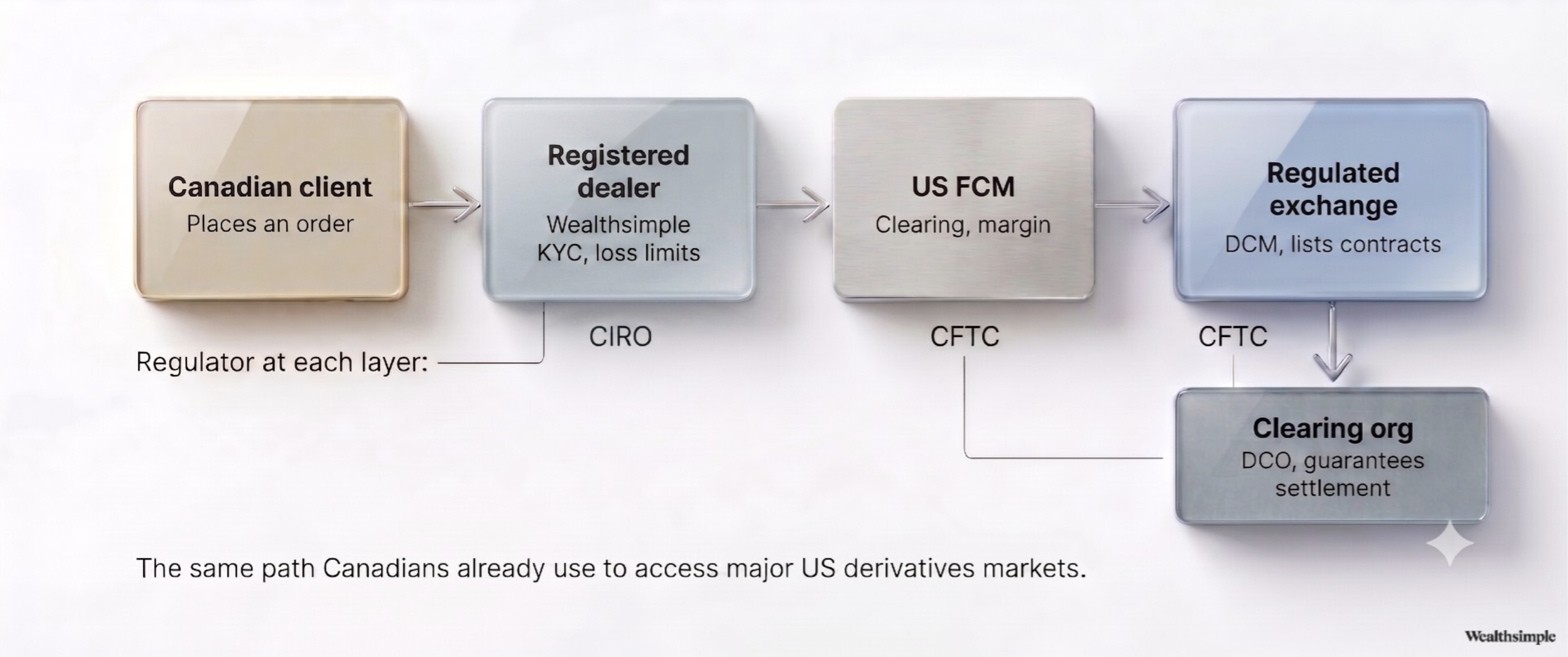
When a Canadian client places an order on Wealthsimple Predict, that order travels through a chain of regulated intermediaries before it reaches the market. A futures commission merchant (the FCM) handles clearing and margin. The order is matched on an exchange (the designated contract market, or DCM) and cleared by a clearing organization (the designated clearing organization, or DCO). Wealthsimple is regulated by the CSA and CIRO, and the FCM, DCM and DCO are regulated by the US Commodity Futures Trading Commission (CFTC). This is the standard path Canadians already use to access major US derivatives markets. In the future, it is possible that event contracts could also trade on Canadian derivatives markets. We would welcome this development: it would involve a similar chain, with each intermediary’s conduct regulated by a Canadian securities regulator.
C. Market structure
Event contracts traded on prediction markets are organized into series (the template) and markets (the specific event contract). For example, a monthly unemployment series automatically generates twelve individual markets each year. That difference turns out to matter, because a rule measured against the timing of the series produces a very different result than the same rule measured against the timing of each individual market. This is the issue raised by the 30-day term-to-maturity requirement in Multilateral Instrument 91-102 – Prohibition of Binary Options (MI 91-102), which we discuss in Section IV below.
III. The Right Regulatory Path
A. Proven protection under a securities regulatory framework
Derivatives markets have operated under formal regulatory frameworks in North America for over 100 years, with exchange-level rules governing manipulation dating back to the 1860s. Those frameworks exist because legislators recognized early that these markets generate risks requiring a specialized regulatory response. Those risks include: manipulation of prices or settlement outcomes, insider trading on non-public information about the underlying event, counterparty default, and inadequate capital at the intermediary layer.
Prediction markets give rise to similar risks at the intermediary network level as other derivatives markets. Settlement turns on an underlying event: anyone with advance knowledge of that event can trade on it. Prices can be moved by large positions. Intermediaries hold client funds. For this reason, the regulatory toolkit applied to futures contracts is the right toolkit for event contracts: the risks that arise across the intermediary chain are the same.
It is important to emphasize that Canadian investors routinely access regulated global markets through licensed intermediaries. For example, a Canadian investor can trade corn futures listed on the Chicago Mercantile Exchange (CME), equity options listed on the Chicago Board Options Exchange (CBOE) or crude oil swaps listed on the Intercontinental Exchange (ICE). In each case, the Canadian investor does so through a CIRO-registered dealer acting as intermediary to a CFTC-regulated exchange. Prediction markets accessed through a regulated Canadian dealer like Wealthsimple are a new product type in an established regulatory structure.
B. Structure determines classification
Section 1(1) of the Securities Act (Ontario) (the OSA) defines a "derivative" by its structure: an instrument whose value, or whose payment or settlement obligations, is derived from, referenced to, or based on an underlying interest. The definition spells out what an underlying interest can be, and the list expressly includes a "value, price, rate, variable, index, event, probability or thing." An event contract fits squarely in this definition. Its value is derived from the outcome of an underlying event. On the plain words of section 1(1), an event contract is undeniably a derivative subject to securities law.
The OSA definition does NOT turn on subject matter. A contract on a central bank rate decision is structurally no different from a contract on the price of gold and no different from the outcome of a major sporting event. Any of these contracts derive value from an underlying event, and require the same oversight. The legislative silence on subject matter in the derivative definition is deliberate: the law classifies instruments by what they are, not what they are about. So the topic of the underlying event does not change the answer. An event contract that derives its value from an event is a derivative, whatever the event happens to be.
C. Securities regulation addresses the actual risks
The risks that event contracts generate are addressed by the securities framework at each layer of the intermediary chain:
- At the dealer layer, the dealer is accountable to CIRO for the conduct of its business with clients. This involves obligations to the client based on information collected (know-your-client or KYC information), capital adequacy requirements, conflicts of interest management, recommended loss limits based on client income and net worth, ongoing supervisory requirements and AML requirements.
- At the FCM layer, the FCM must meet the capital adequacy and risk management requirements set by the CFTC, and is accountable to the CFTC for maintaining sufficient capital resources to meet its obligations, in addition to complying with AML requirements.
- At the exchange (DCM) layer, every contract listed must satisfy the Core Principles set out in the US Commodity Exchange Act, the baseline standards that govern what trades on the exchange. These include requirements that every listed contract resist manipulation, and that the exchange surveil its markets and ensure reliable settlement.
- At the clearing (DCO) layer, the clearing organization guarantees settlement and manages counterparty risk under CFTC oversight.
The Canadian securities law framework is the only legal regime that can govern the interaction of Canadian investors and dealers with US intermediaries. It already reaches every Canadian-facing layer of the chain and operates alongside the US framework that governs the FCM, the DCM, and the DCO.
D. A new or additional regulatory framework adds no protection but creates real costs
Some have suggested that certain event contracts need a second layer of regulatory oversight in addition to securities law, based on the subject matter of the contract. The idea put forward is that both securities and gaming law should apply to certain prediction markets, like sports. This view has surface appeal, but it reflects a misunderstanding of the protections embedded in securities law.
It helps to separate two questions that often get tangled together. The first is whether an event contract is a derivative. That is a structural question, which we addressed above. The second question is whether a particular derivative should be offered to retail clients. That is a conduct question, and it can be answered within the securities framework. Dealers decide which contracts to make available, and regulators supervise that decision. If Wealthsimple chooses not to offer a contract, and this paper describes several categories we intentionally exclude, or if regulators do not permit it, that does not make the contract something other than a derivative subject to securities regulation. It just means no one chooses to offer it or no one is permitted to offer it.
Consider the objection that some event contracts serve no real economic or hedging purpose, so they should be regulated as entertainment or gaming. Economic purpose has never been the test for whether an instrument is a derivative under Canadian law. Many plainly financial derivatives are bought and sold purely to speculate, with no hedging rationale, and they remain securities-regulated all the same, because the risks they create across the intermediary chain do not depend on why any individual trades. The CFTC recently took the same view: in proposed rulemaking issued in June 2026, it stated that an event contract need not have hedging or pricing utility to be permissible. Whether a contract serves a hedging purpose may inform whether a dealer should offer it. It does not change what the contract is.
E. Prediction markets belong with securities regulation, not gaming regulation
Instead of an additional layer, some have proposed going even further: assign responsibility for regulating certain event contracts, based entirely on the subject matter of the contract, to gaming regulators instead of securities regulators. Such a bifurcation of oversight of organized derivatives markets would be unprecedented, and in our view, ineffective.
An argument can be made that an event contract fits the Criminal Code definition of a “bet” as well as the definition of a “derivative” under provincial securities and derivatives law, and for that reason gaming regulatory oversight is necessary. However, that potential for overlap is not new, nor is it predicated on the nature of the underlier of the event contract. In our view, expanding the interpretation of the Criminal Code definition of a “bet” to encompass speculative trading of derivatives on regulated markets is both ungrounded in law and inconsistent with established approaches for dealing with potential overlapping regulatory regimes.
Canadian securities regulators have faced this overlap before. Section 2(1) of OSC Rule 91-506 – Derivatives: Product Determination prescribes that a gaming contract that is already regulated under gaming control legislation is not a “derivative” specifically (and only) for the purposes of over-the-counter derivatives data reporting. The rationale for this exclusion is found in the companion policy to the rule: the companion policy states that while a gaming contract comes within the definition of a derivative, gaming operators do not need to report these contracts to a derivatives data repository for review by securities regulators because they do not pose the same potential risk to the financial system as other derivatives products.
We agree: a gaming operator taking the other side of a bet against its customer does not pose such a risk to the financial system that derivatives data reporting is required, and gaming regulation is designed for that bilateral relationship. However, as noted above, prediction markets are not “bets” against a house. They are two-sided markets that require capital adequacy, segregation of funds, clearing integrity, and market surveillance. These are financial derivative risks, which securities regulators are uniquely equipped to manage. A gaming regulator has no framework for them.
This brings us to the specific proposal that certain contracts, such as those on sports outcomes, should be assigned to gaming regulation while the rest stay under securities regulation. This is unworkable and does not reflect the structure of these contracts or markets. A contract on the outcome of a soccer match and a contract on the level of inflation are, mechanically, the same instrument. Each is a binary contract that derives its value from an underlying event, and each reaches a Canadian client through a chain of intermediaries.
Dividing up the regulatory oversight of derivatives instruments that operate in identical ways, and differ only by subject matter, is the wrong approach. It would be unprecedented in Canada. We do not operate in a system where securities issued by telecommunications companies or banks are regulated differently than securities issued by mining companies or technology companies. Securities are securities, and issuers must all follow the same set of rules, no matter the industry they operate in.
The inverse is also true. To the end consumer, a segregated fund issued by an insurance company and an investment fund managed by an investment manager may serve a very similar purpose, and on the surface resemble one another. But structurally, they are different, and that difference results in very different regulatory models, with segregated funds regulated by insurance regulators and mutual funds regulated by securities regulators. In this same vein, we believe it is appropriate for bilateral sports betting, where a gaming operator sets the odds and takes the other side of the bet, to be regulated under gaming laws, while sports event contracts that are traded and cleared by regulated derivatives market intermediaries to be regulated under securities laws.
Finally, some say a gaming framework should apply because prediction markets, like gambling, can be habit-forming, and gaming regulation tackles that through responsible gaming rules. That is a valid concern, and it’s covered under securities law. Section 2.1 of OSC Rule 31-505 – Conditions of Registration requires registered dealers to deal fairly, honestly, and in good faith with their clients. In our view, these conditions of dealer registration set a very high conduct bar, equal to or exceeding responsible gaming principles, and they are the foundation for the responsible trading protections that we are building into Wealthsimple Predict.
IV. Strengthening the Framework
The securities regulatory framework is the right one for prediction markets, but it can be strengthened and refined to move from interim measures to permanent, effective regulation.
A. Modernizing the binary options rules
MI 91-102 was adopted in 2017 in all provinces and territories, except British Columbia, to address a specific and well-documented problem: fraudulent offshore platforms marketing binary options to retail investors. These were contracts sold over-the-counter and promoted through misleading marketing as legal and legitimate when in fact no firm was authorized to offer them to retail investors in Canada.
MI 91-102 was a strong response by the CSA to fraud being committed by offshore platforms. It was not aimed at legitimate dealers operating within the regulatory perimeter. Its purpose was to disrupt the distribution of these products and to raise awareness among investors that their sale was illegal.
Event contracts traded on derivatives markets have some resemblance to binary options because both present a yes/no proposition about a future event and pay a fixed amount if the proposition is met and nothing if it is not. But that is where the similarity ends. An event contract traded on a regulated derivatives exchange through a chain of regulated intermediaries is far removed from the binary options traded bilaterally with fraudulent offshore platforms.
We believe that, after being in force for nearly a decade, it’s time to update or replace MI 91-102 to better address the factual underpinnings of prediction markets. We still need regulation to prevent fraud and unauthorized business from offshore platforms, but other features of MI 91-102 do not make sense in the present context.
B. Examining the 30-day requirement in MI 91-102
MI 91-102 provides that a contract cannot be offered to retail clients unless it is listed by the exchange at least 30 days before it matures, that is, before the date the underlying event is determined. Designed to fight fraud, it is a poor fit for exchange-traded event contracts. For one thing, it does little in practice to protect anyone, since it doesn't limit when a client trades - clients can still trade up until the time the contract matures, so long as the contract has been listed for 30 days. For another, it is unclear how to even measure the requirement, because of how regulated exchanges organize event contracts. Since event contracts are organized in series that automatically generate individual markets on a rolling cadence, the 30-day requirement means something different depending on whether it is measured against the listing date of the series or against the listing date of each individual market.
Another rationale given for the 30-day requirement is to discourage short-term speculative trading. Respectfully, imposing a 30-day listing requirement for event contracts is not the way to do that, and inconsistent with other financial instruments readily available to Canadian retail investors. When Canadians buy stocks, they are not forced to hold that stock for any length of time (and certainly not 30 days) or restricted from buying stocks that have been listed within 30 days. Similarly, when Canadians buy S&P futures or listed options, they can buy and sell on the same day, including the day a contract expires.
In our view, the best way to resolve the interpretive issue of applying the 30-day requirement, and to address any potential harmful effects of short-term speculative trading, is to replace the 30-day requirement entirely with dealer conduct requirements, including individual recommended loss limits and responsible trading tools that address the actual risks associated with speculative trading. We discuss both of these below.
C. From topical categories to settlement source
This spring, the CSA and CIRO issued notices to describe permitted event contracts by topical category: financial, economic, and environmental. On the surface, this approach is intuitive - permit trading of event contracts that have underliers that appear to most closely relate to capital markets and investing. But topical categorization is subjective: the same contract can fairly be sorted into more than one category, or none of them, and contracts that are alike in every way that matters can end up in different boxes, depending on who is doing the labelling. This produces inconsistent results and forces continuous updating as new contract types appear.
We propose to instead organize and regulate event contracts by settlement source. The “settlement source” is the data provider or institutional authority whose published data determines whether a contract resolves in favour of the yes position. To illustrate this, consider a contract on Canada’s population passing a stated threshold. The settlement source is data published by Statistics Canada, a national statistical agency. That is the same government statistical source that settles event contracts based on unemployment data. The topics differ, but the settlement source is of the same type: an authoritative government agency publishing official data on a fixed schedule. A regulatory framework organized by “topic” or “category” could treat these two contracts differently. A framework built on the settlement source treats them the same. We believe this is the correct result.
Take a contract on the price of Bitcoin. Its settlement source is CF Benchmarks, a recognized financial index provider and the same source the CME uses for its Bitcoin futures. Try to sort that contract by topic and you could call it financial, economic, or perhaps “crypto”, each with a reasonable argument. That kind of subjective guesswork shouldn't drive whether a dealer makes a contract available to clients. The settlement source gives a cleaner answer: in this example, an accredited financial benchmark that settles other approved financial contracts.
The settlement source principle is grounded in section 1(1) of the OSA. As discussed above, a derivative takes its value from an underlying interest, and for an event contract that underlying interest is the event itself. The settlement source is the authority whose pronouncement determines whether that event has occurred, and so resolves the contract. Classifying by settlement source is a way of identifying and assessing the underlying interest at its most concrete: the specific, verifiable data point on which the contract turns. This is consistent with CFTC staff guidance, which provides that a product submission for an event contract should identify the specific data source on which settlement will be based and assess the reliability, objectivity, and manipulation resistance of that source.
D. Settlement source categories
We propose four settlement source categories. Others may be developed in time.
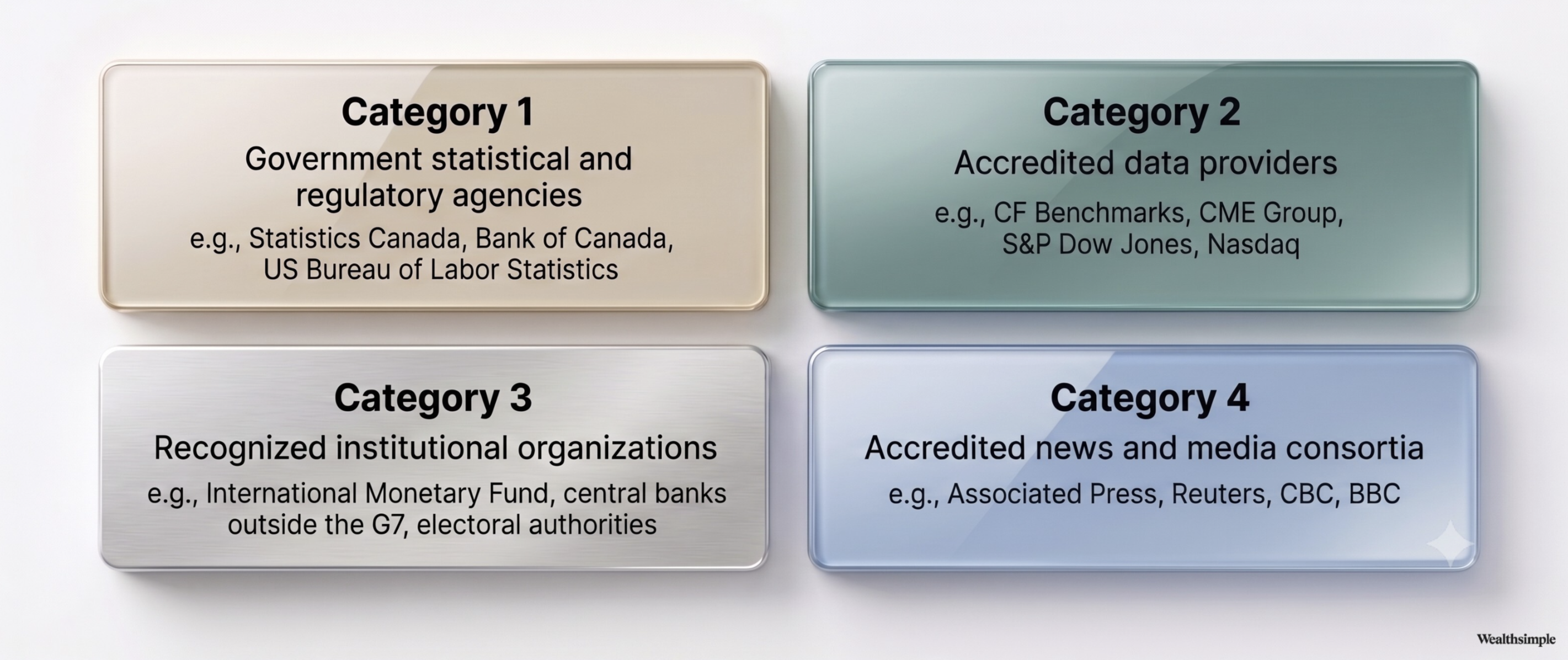
- Category 1: Government statistical and regulatory agencies. The source is a government body with a published methodology, an established release calendar, and no commercial incentive to adjust outcomes. Examples include Statistics Canada, the Bank of Canada, the US Bureau of Labor Statistics, the US Federal Reserve, the US National Oceanic and Atmospheric Administration, the US Centers for Disease Control, the US Securities and Exchange Commission, and equivalent agencies in other G7 jurisdictions.
- Category 2: Accredited data providers. These sources operate under regulatory supervision and/or publish their calculation methodologies and maintain established data integrity standards. Examples include CF Benchmarks, CME Group, S&P Dow Jones Indices, Nasdaq, the New York Stock Exchange, ICE, and equivalent providers.
- Category 3: Recognized institutional organizations. These are established international and institutional bodies with a defined mandate and published outputs. Examples include the International Monetary Fund, central banks outside the G7, and accredited electoral authorities. Settlement source reliability is assessed at the individual source level.
- Category 4: Accredited news and media consortia. These are organizations operating under editorial standards with established fact-checking processes. Examples include the Associated Press, Reuters, the CBC, and the BBC. A news or media consortium is an appropriate settlement source where it is genuinely the authoritative record of the event, not where a specialized body, such as a scientific agency or electoral authority, owns the determination.
Applying the settlement source framework, the question for regulators and regulated market participants is always the same: what is the settlement source, and does it satisfy the structural test for a recognized category? If the contract settles on a source already within one of the four categories, it would qualify to be offered by a regulated dealer like Wealthsimple. If it settles on a source of a kind not seen before, that source is tested against the criteria that define the settlement source categories to determine whether it belongs in one, or not. If the settlement source does not belong in one of the four categories, then the event contract cannot be traded.
V. Choosing What to List: Contract Governance
As a registered dealer, we decide which event contracts to make available to our clients. We don't offer a contract simply because an exchange we connect to has listed it. We apply our own framework, on top of the conditions CIRO sets for our product, to consistently and deliberately choose which contracts to offer. This section describes how it works.
A. Settlement source as the foundation
Contract selection at Wealthsimple begins with the settlement source principle. A contract is eligible for consideration only if it settles on an approved source in one of the four settlement source categories. A contract could fit squarely within a CSA and CIRO topical category like "environmental" and still fail our test if its settlement source is not appropriate. As an example, we recently declined to make available a contract on whether a supervolcano would erupt before 2050, because the exchange had set a news outlet as the settlement source. For an event like that, the authoritative record is a scientific body such as a national geological survey or similar government source, not a news report.
B. Absolute prohibitions
We will not list certain contracts, even if the settlement source is sound. We prohibit contracts involving mortality, armed conflict, personal harm and terrorism. These four prohibitions track the public interest standard that the CFTC applies under the US Commodity Exchange Act. The fifth, “single-actor manipulation,” is a structural prohibition that we apply for the same public interest reason.
- Personal harm, including death and mortality. No contracts where settlement depends on whether a specific person is alive or dead.
- Initiation of armed conflict. No contracts referencing or capable of incentivizing the start of armed conflict. Contracts on the cessation of conflict, such as a peace agreement, are permitted. The line is drawn at initiation.
- Personal harm and violence. No contracts on the physical safety or personal circumstances of identifiable living individuals.
- Terrorism. No contracts referencing acts of terrorism.
- Single-actor manipulation. No contracts whose outcome can be unilaterally determined by a single identifiable individual. This prohibition is Wealthsimple-specific and is described in detail below.
C. Unpacking the single-actor prohibition
We exclude a contract if a single identifiable person could, by their own unilateral action, determine whether it resolves yes because we believe that it is too open to manipulation. For example, an event contract that resolves based on the words spoken by a CEO on an earnings call would not pass muster. If one person can decide the outcome of a contract, then that person, or anyone who knows what they intend to do, can trade on that information. A subject-matter topical classification for event contracts misses this, because it screens for the topic of the contract rather than the feature that creates the danger.
This is different from a contract where one person has influence but the outcome still runs through an institutional process. For example, a contract on whether the US President will sign at least one bill into law in a given month requires that bill to pass both chambers of the US Congress first. As another example, a contract on whether a head of government will leave office can be resolved through resignation, election defeat, impeachment, or a vote of no confidence. Further, a central bank rate decision is made by a committee under a published mandate, with documented deliberation. In our view, influence over an outcome is not the same as sole discretion over it.
D. Our governance process
Every event contract series that we make available to clients passes through our governance process. The process applies the settlement source principle and the five absolute prohibitions, including the single-actor test. It also confirms the remaining listing criteria: that the contract’s resolution terms are objective and verifiable, that the settlement source has been correctly identified and classified, and that the contract meets the applicable term-to-maturity requirements. Edge cases are escalated and documented, and our decisions are maintained as records subject to CIRO supervisory oversight.
VI. Responsible Trading & Investor Protection
We have adopted a range of additional responsible trading and investor protection measures that we believe help clients access and trade on regulated prediction markets responsibly.
A. Separate app
We are introducing Wealthsimple Predict in a separate app. We believe that using Wealthsimple Predict should be a deliberate choice by our clients. We chose to introduce Wealthsimple Predict to Canadians in a separate app that clients will be required to take affirmative steps, like downloading a new app, to reinforce that choice.
B. Capped downside and protection of funds
The risk profile of an event contract is more constrained than that of other derivatives available to Canadian retail investors, including other derivatives offered through Wealthsimple. When buying an event contract, a client can lose no more than the amount they pay. In our product, there is no leverage, no margin call, and no negative balance. The maximum loss is known at the time of purchase. Further, all prediction market trading takes place in a non-registered account, so the cash and event contracts in a client's account are eligible for CIPF coverage in the event of Wealthsimple's insolvency.
C. Recommended loss limits calibrated to the client
When a client opens an account on Wealthsimple Predict, we use the income and net worth they provide through the KYC process to assign a risk tier, and that tier sets their recommended loss limit. The recommended loss limit is a dollar amount determined based on the client’s financial circumstances. At the lowest tier it is a fixed floor. At higher tiers it scales with income or net worth, so a client with more financial capacity has a higher limit and a client with less has a lower one.
The recommended loss limit is not a cap on trading. It is the point where we start to intervene, and we do so gradually. As a client’s losses, realized and unrealized, approach and then pass the limit, they get a sequence of warnings: first an email, then a further email if losses keep climbing, and then an in-app prompt asking them to review their account and acknowledge what they have lost. We do not sell a client's positions just because they have passed their limit.
D. Responsible trading tools
Alongside the loss limit, we are developing a range of additional responsible trading tools, each designed to go beyond current regulatory requirements. They include:
- Deposit limit. A user-configurable weekly or monthly cap on funds transferred into the Wealthsimple Predict product. Tightening would take effect immediately, while loosening would require a 24-hour cooling-off period.
- Break in trading. A self-initiated trading suspension of 1 day to 3 months. Once set, it could not be cancelled early.
- Self-exclusion. A longer-duration opt-out of 6 months, 1 year, or 5 years, applying to Wealthsimple Predict only, with funds returned within 24 hours. This tool would directly address compulsive trading behaviour: a client who recognizes that their trading is causing harm could remove their own access without relying on an external process.
- Persistent responsible trading footer. Visible at all times within the product, providing links to the responsible trading settings page and to external support resources.
This approach reflects our view that investor protection in this product means giving clients the information and controls to manage their own participation, rather than restricting access in ways that push people toward unregulated alternatives.
E. Education throughout the client journey
At account opening, every new Wealthsimple Predict client must complete an education module, which is an onboarding sequence explaining what event contracts are, how they resolve, and the maximum loss on any position. But education will not stop at onboarding: Wealthsimple will also surface relevant information at key points in the client journey:
- when browsing markets, a resolution card for each contract explains how it will settle and what the settlement source is, with a warning where trading volume is low;
- on a first trade, a short walkthrough explains what the client is buying and the maximum loss; and
- in the portfolio view, a reminder that positions can be sold before determination, shown alongside realized and unrealized exposure.
F. Insider trading and three-layer surveillance
Any market that settles on real-world events raises an important concern: insider trading, where someone with specific knowledge of an outcome unlawfully trades on it. This is not unique to prediction markets. It is the same risk that securities regulators have long managed across regulated markets. We believe that the tools that securities regulators use to detect and enforce against insider trading, in close coordination with regulated market intermediaries, can be applied effectively to prediction markets, and far better than any alternative that may be offered by gaming regulators.
Protection against insider trading breaks down into three layers. First, Wealthsimple applies KYC and insider trading standards, including AML checks, at the dealer layer. We already have obligations to report suspicious transactions, and we will observe those obligations with Wealthsimple Predict. Second, the FCM that routes client orders to the exchange conducts independent surveillance of trading patterns, with escalation obligations if any improper patterns are detected. Finally, a prediction market exchange operates with real-time market monitoring, and does its own enforcement and regulatory reporting in cases of improper trading. Wealthsimple, the FCM and the exchange are all regulated.
Regulators will need to refine existing legal frameworks for what it means to unlawfully trade on real world events. In some circumstances, it is unambiguous. For example, an official at the Bank of Canada who has confidential knowledge of a rate decision is not permitted to trade on that knowledge; to do so would constitute fraud and be a breach of their confidential obligations as an employee of the Bank. However, it is lawful for members of the public to analyze publicly available information and make trades based on what they learn. As an example, a member of the public who records the number of ships that travel through the St. Lawrence Seaway may trade on shipping volumes without concern of violating insider trading rules. This is no different than equity capital markets, where investors may conduct primary research to gain legitimate advantages in the market. These distinctions are important, and our regulatory regime and jurisprudence will need to advance to account for them.
VII. Conclusion
Prediction markets are a place to express a view, or a place to gather information about the views of others. The price of an event contract aggregates what a large and dispersed group actually believes about an uncertain event, often faster and more accurately than polls, commentary or the latest hot take shared on social media. The prices of event contracts are a public forecasting tool that decision-makers can and do draw on. Event contracts also let people and businesses hedge real exposures, much as other derivatives do. A borrower worried about rising rates can hold a position that pays if rates climb.
Prediction markets are not without challenges. For example, thin trading can make some prices noisy. Also, some event contracts can be prone to manipulation (which is why Wealthsimple is selective about which contracts to make available). But the answer to those challenges is good regulation and good compliance by regulated market participants, not prohibition. We have built a framework that is protective, principled, and ready for oversight. And by providing a regulated alternative to offshore platforms, we give Canadians a way to access these markets safely.
Ultimately, observing client and market behaviour will be the best method to develop evidence-based regulations for prediction markets. We look forward to contributing data to the CSA and CIRO in furtherance of this work, and to working with governments across Canada on how best to give Canadians responsible access to prediction markets while addressing the potential for investor harm or market abuse.
Regulated financial markets have the power to grow our economy, manage risk and create prosperity, and we welcome the role that regulated prediction markets can play to realize this potential.
Authors
Blair Wiley, Chief Legal Officer, Wealthsimple
Catherine De Giusti, VP Product Legal and Deputy General Counsel, Wealthsimple
1. In May 2026, Angus Reid found 4% of Canadian adults have personally used prediction markets, equating to about 1.3 million people.