The Market Mindset: most couples budget for their wedding. They overspend by nearly 70%.
August 20, 2026
.png)
Canadians are facing unique financial headwinds — sky-high housing prices, economic uncertainty, and technological disruption. As a result, we are seeing retail investors become more resourceful than ever. They are increasingly confident, engaged, and willing to take control of their financial futures. The Market Mindset is a series exploring how Canadians think about the present and future of investing.
A wedding can be one of the most significant romantic milestones in a couple's life—and often one of the most expensive. A typical¹ couple we surveyed spent $25,000 on their wedding. For those who haven't yet bought a home or a car together, it may well be the largest single purchase they've ever made as a pair.
As wedding season peaked in July, we surveyed 1,236 Wealthsimple clients about the cost of weddings, whether they were paying for their own or turning up for someone else's. We heard from recent newlyweds, guests and wedding-party members, newly engaged couples, and people who'd put off marrying because of the price. One thing came through clearly: while worth it, weddings cost far more than couples expect. And the newly engaged are bracing for even higher costs.
Couples drastically underestimate wedding costs
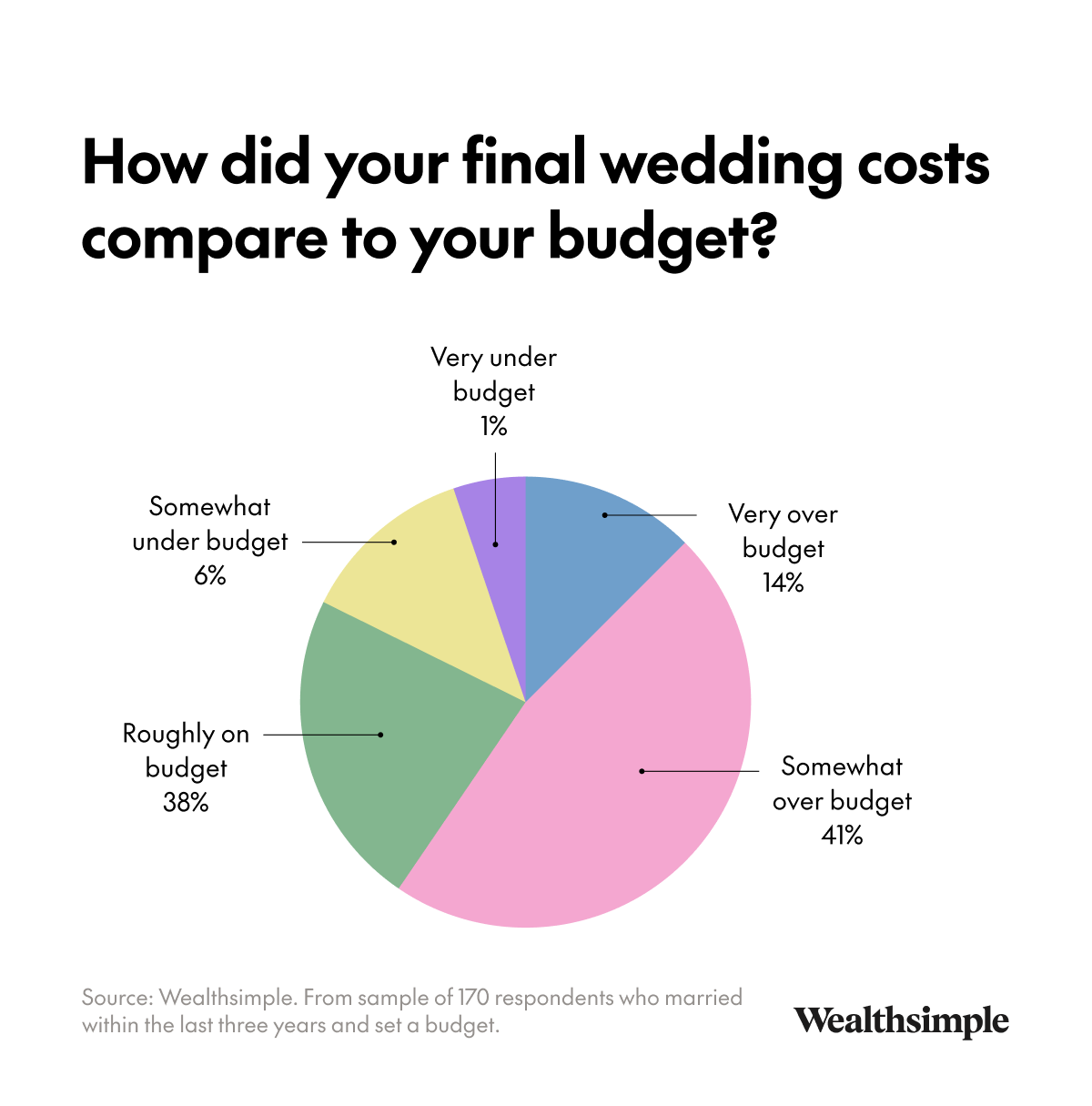
Maintaining financial discipline while juggling attire, rings, entertainment, venue fees, and catering is often an uphill battle, and one a lot of couples aren't set up to win. Of the newlyweds we surveyed, 69% felt pressured to spend more than they were comfortable with. And by and large, they did.
.png)
A typical¹ couple budgeted $15,000, mostly drawn from personal savings, but their final bill came to $25,000—around 70% higher. And that $25,000 is only the midpoint. Averaged across everyone, the bill ran closer to $37,000 because of a small number of very expensive weddings. To cover the shortfall, many couples turned to secondary funding: 28% relied on family, 26% used a credit card, and 9% took out a line of credit.
The more you earn, the more stressful it is paying for a wedding
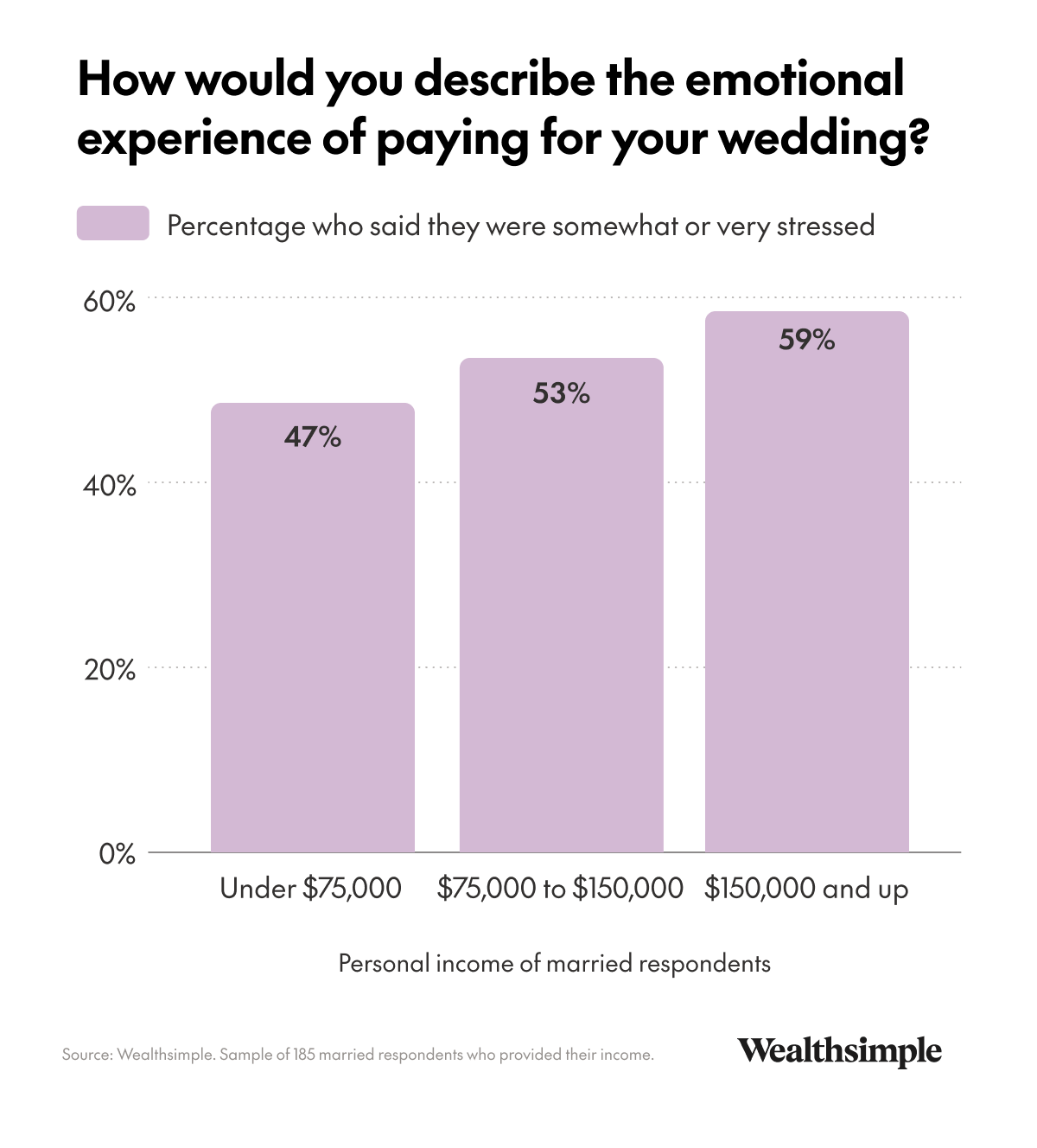
We expected our wealthiest respondents would find it the easiest to stomach the cost of a wedding. The opposite was true. While 47% of our respondents who earned $75,000 or less said they were stressed about paying for their wedding, that number rose to 59% for respondents with personal incomes of $150,000 or more.
.png)
What's clear from our data is that couples are pressured to spend a fortune on their weddings, and wealthier couples may have it worse: 58% of the top earners blew their budgets compared to 46% of couples earning $75,000 or less. No matter their income, overspenders were more likely to regret their wedding spending than those who stayed within their budget.
One in three guests has skipped a wedding or pre-party over cost
Cost isn't just the happy couple's problem. Guests and wedding-party members told us they also find weddings financially stressful, with 36% saying they'd turned down at least one wedding or pre-event invite (such as a bachelorette party) in the last three years. Another 22% accepted the invite, but said attending was financially stressful or difficult for them. And 14% took on debt to go. It's also no surprise that nearly a third (32%) of newlyweds told us money became a point of tension with their family and friends as they planned their wedding.
Ordinary guests can spend hundreds of dollars on clothes, jewellery, travel, and accommodations. We found 22% of wedding guests spent over $1,000 to attend a single wedding. Wedding party members had it even harder: 39% told us they'd spent double or more—at least $2,000.
Some couples shrink their weddings. Others call it off.
Dream weddings don’t have to be big, and not every couple set out to go small, but many ended up with modest guest lists. Only 14% of newlyweds we spoke to said they planned a small wedding from the start, yet 22% hosted micro-weddings of fewer than 25 guests, and around a third (36%) had 50 guests or under.
.png)
A wedding often competes with other big financial goals. Nearly a third of couples (31%) told us they loved their wedding but, given the chance, would spend less and put the difference toward another financial priority like a down payment, savings, or long-term investments. And debt lingers: 14% were still paying off their wedding up to three years later.
Access to funds is a major barrier to a wedding. When we talked to respondents who’d put off or decided against a wedding, 93% cited cost as a significant reason, and 41% said it was the main reason. But the desire hasn't gone away: 68% said they'd still have a wedding if money were no object.
Newly engaged couples are bracing themselves
We’ve talked a lot about financial anxiety, but it’s worth noting just how many stressed couples would still, in spite of it all, say ‘I do.’ Three-quarters of newlyweds said they were comfortable with or proud of what they spent on their wedding. Only 12% regretted it.
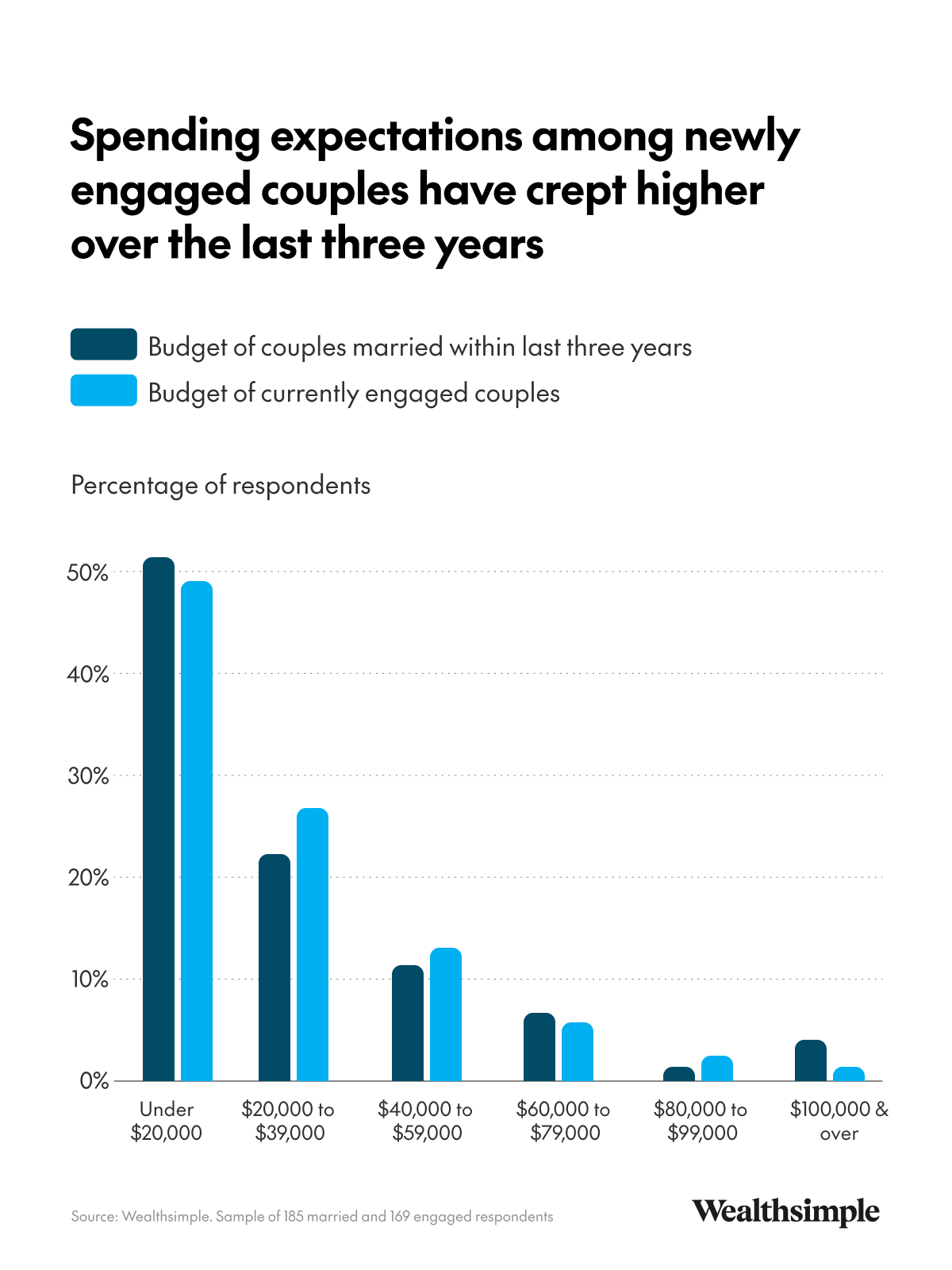
Newly engaged couples, though, are a lot more realistic about financing their wedding, even when compared to those who tied the knot within the last three years. Around a quarter of engaged couples said they’re planning a small wedding out of cost concerns (compared to 14% of the recent newlyweds we spoke about earlier). A typical engaged couple now expects to spend $25,000—well above the $15,000 recent newlyweds set out to spend, and right in line with what those weddings actually ended up costing.
Whether you're getting married or attending as a guest, wedding costs add up, and a little planning goes a long way. The couples who feel most in control set a realistic number early, leave room for the overage that usually comes, and weigh the wedding against goals like a home or savings so one big day doesn't set back the years that follow.
A major expense like a wedding often means balancing immediate costs with longer-term financial goals. A portfolio line of credit is a low-rate option, letting you borrow against eligible investments without selling them, so they can stay invested while you cover those often-hefty expenses.²
¹"Typical" refers to the median: the midpoint of all responses.
² Wealthsimple’s portfolio line of credit account margin rate is P-0.5% for Generation clients, P+0% for Premium clients, and P+0.5% for Core clients. Prime rate is 4.45% for CAD as of December 11, 2025. Subject to change. Annualized rate, calculated daily, charged monthly. All investments involve risks. See here for details. Because the credit is secured by your investments, no credit check or lengthy application is required, and credit is available within minutes. No minimum payments are required.